Source context: BullSpot report from 2026-05-20T10:36:50.798Z (Fresh report: generated this cycle).
The Typist in the Word Processor Age
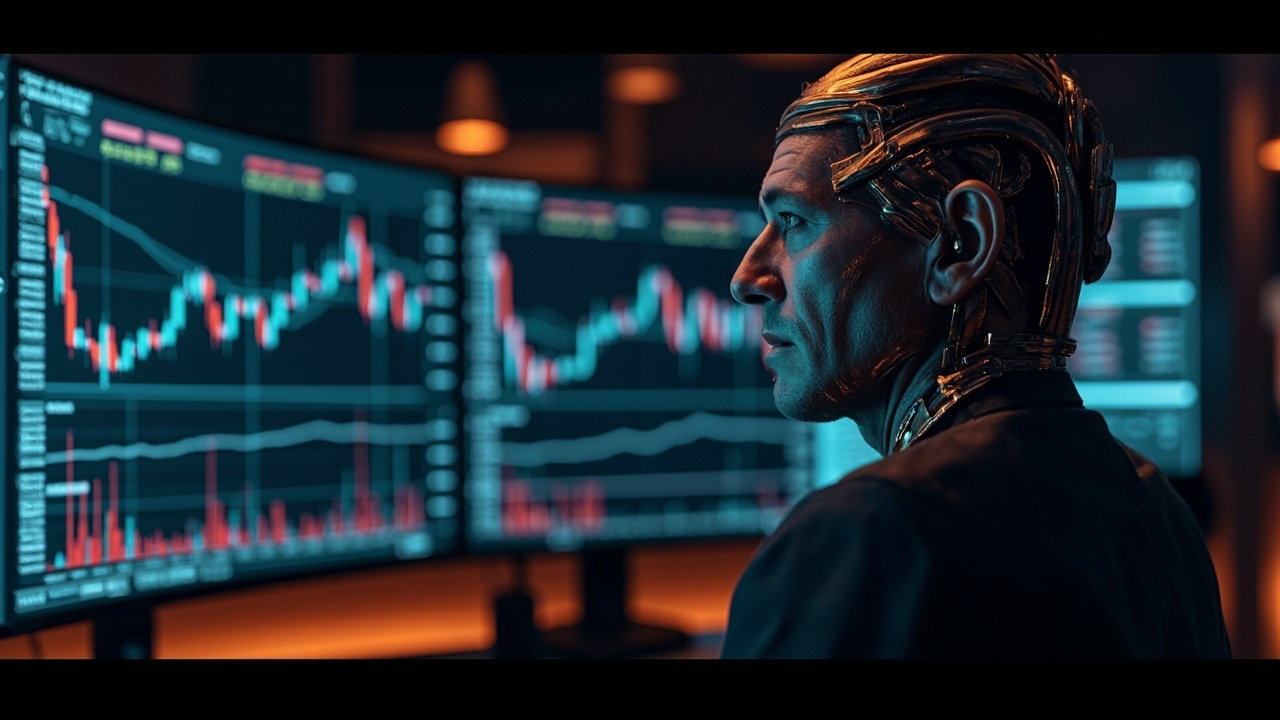
Let me paint a picture. You're staring at three monitors at 2 AM, caffeine in hand, watching BTC grind through what your analysis says should be a breakout. You notice ETF inflows hitting $153.87M for the week—solid institutional demand. You see the 4H Bullish BOS confirmation at $77,055. Your gut tells you to wait. Your spreadsheet tells you something else. You pull the trigger, second-guess yourself, and miss the move entirely.
Meanwhile, BullBot has already processed the EMA ribbon alignment across 1H, 4H, and 1D timeframes. It factored the ATR compression to $318 (0.41% of price) indicating a volatility contraction phase. It cross-referenced Reddit sentiment reading BEARISH at -34.3—which historically precedes reversals. It recognized the liquidity cluster sitting just below at $77,600-$77,754. It made a decision, executed it, and moved on.
You lost sleep. It didn't.
This isn't a hypothetical. This is the trading floor right now, in 2026. The gap between manual traders and agentic AI isn't theoretical anymore—it's performance.
What "Agentic AI" Actually Means
Let me be precise because "AI" has been sloppily slapped on everything from spreadsheets to chatbots.
Agentic AI refers to autonomous systems that can reason, plan, act, and learn without human intervention in real-time. Not reactive pattern matching. Not if-this-then-that automation. Real-time decision-making that accounts for context, adapts to changing conditions, and compounds knowledge over time.
A traditional bot follows rules you wrote. If price crosses X, do Y. If RSI hits 70, sell. It's a sophisticated thermostat—impressive within its parameters, helpless outside them.
An agent observes the market state, evaluates multiple variables simultaneously, decides on action based on probabilistic outcomes, executes, monitors the result, and updates its internal models based on what happened. It does what a competent human trader would do—if that human never got tired, never missed a signal, and never repeated the same mistake twice.
The distinction matters because the capabilities are fundamentally different. One is automation. One is agency.
The Evolution Nobody Talked About (Until Now)
Manual trading was the only option until the late 2000s. Then came signals and alerts—someone else's analysis pushed to your phone. Better, but still laggy and dependent on another human's schedule.
Rule-based bots came next. These were programs that executed when conditions were met. Useful, but brittle. They couldn't tell you that a news event was about to invalidate their parameters. They couldn't read the room.
Now we're in the agentic era. Systems that don't just execute—they think. They maintain context across timeframes. They coordinate decisions with a clear rationale that can be reviewed and refined.
Most traders haven't processed this shift yet. They're still debating whether bots are "real" trading, just like swing traders in 2015 dismissed algorithmic trading as cheating. The market doesn't care about your philosophical objections. It only cares about results.
Why BullBot Is Different: A Trade Walkthrough
Let me walk you through what actually happens when BullBot processes a market setup like the current BTC situation.
Scan: BullBot ingests order flow data, on-chain signals, social sentiment readings, and technical confluence across multiple timeframes simultaneously. Right now, it's noting the confirmed Bullish BOS at $77,055, the rejected bearish OB zone at $77,254-$77,596, and the ATR compression signaling imminent displacement.
Reason: It doesn't just see the data—it evaluates relationships. It recognizes that ETF inflows of $153.87M provide floor demand that hasn't yet translated to price action. It flags that Reddit sentiment reading BEARISH at -34.3 historically precedes reversals. It notes Bollinger %B at 104.5% signaling short-term overextension that may mean-revert.
Decide: Based on the confluence of bullish technical structure and bearish sentiment creating a potential liquidity grab setup, it calculates position sizing and risk parameters appropriate to the current regime.
Execute: It places orders with precision, targeting the liquidity pools above at $77,754 where weak longs are likely to get squeezed.
Monitor: It tracks the trade in real-time, adjusting if the thesis invalidates. ATR expansion beyond $318 signals the volatility contraction phase is ending—a new context requiring re-evaluation.
Learn: Every outcome feeds back into its models. If the liquidity sweep failed to materialize, it updates its probability estimates for similar setups.
This is not a workflow. This is a trading intelligence operating at a tempo human traders physically cannot match.
The 24/7 Advantage Nobody's Quantifying
Here's something traders underestimate until it's pointed out: markets never close, but human attention does.
When you're sleeping, BullBot isn't. When you're at work, BullBot isn't. When you're emotionally compromised after a bad trade, BullBot isn't.
The crypto markets run 24/7/365. Your ability to monitor them runs maybe 12 hours a day if you're disciplined, maybe 4 hours if you have a job. That's a 6x disadvantage in coverage, compounded by the fact that the most significant price action often happens during off-hours—exactly when retail traders are asleep and institutional participants are thinning out.
BullBot's coverage is total. When ETF flows hit during Asian hours, it sees it. When funding rates shift on Binance at midnight, it responds. When a liquidity pool gets hunted while you're dreaming, it has already positioned accordingly.
This isn't a small edge. In markets where information is perishable and positioning is everything, continuous coverage is a structural advantage that compounds over time.
Compounding Intelligence: The Exponential Edge
Here's the part that should make every manual trader uncomfortable.
Every trade BullBot executes generates data. Every outcome refines its models. Every market regime teaches it something about regime transitions. This knowledge compounds.
Your tenth trade teaches you something. Your hundredth trade teaches you something else. But you're one human with limited bandwidth, and you forget more than you remember.
BullBot's thousandth trade builds on the knowledge from its first 999. The pattern recognition improves. The context awareness deepens. The probability estimates become more precise. The feedback loop doesn't just continue—it accelerates.
This is why the gap between agentic systems and manual traders will widen, not narrow. Each cycle, the agent gets better at being an agent. Each cycle, the manual trader gets slightly more tired and slightly more prone to the psychological errors that degrade performance over time.
The knowledge advantage isn't linear—it's exponential. And once it starts, it's hard to close.
What's Coming Next: The Portfolio Agent
The current agentic systems are sophisticated but focused. BullBot scans, reasons, decides, and executes on specific setups.
The next generation does something more profound: it manages entire portfolios across multiple timeframes and asset classes simultaneously.
Imagine an agent that coordinates BTC swing positions with ETH swing positions while managing SOL day-trade entries—all with coordinated risk parameters that account for correlation risk. Imagine an agent that can pull liquidity across exchanges to capture arbitrage opportunities while simultaneously optimizing for fee structures. Imagine an agent that reads macro signals (global liquidity cycles, regulatory developments) and shifts portfolio allocation between crypto and stablecoins based on regime probability.
We're not there yet. But the architecture is being built now. BullSpot is building toward this. The components are in place—the integration is coming.
Why Early Adoption Matters More Than Perfect Timing
Retail traders have a problem: they're competing against institutional players with better data, better infrastructure, and more resources.
Agentic AI is the great equalizer. Not because it makes retail traders into institutions overnight, but because it gives them access to continuous intelligence, disciplined execution, and compounding knowledge that was previously only available to hedge funds with trading desks.
The traders who adopt agentic systems now will have years of compounding intelligence advantage over those who wait. It's like adopting the internet in 1995 versus 2005—the early adopters built the companies.
The window isn't closing. But the edge is largest for early movers, and it will compress as adoption grows.
The Honest Truth About Manual Trading
Manual trading will become what handwritten ledgers are to Excel. Technically possible. Emotionally satisfying for some. But genuinely inferior for any serious purpose.
You can still manually trade. You can still watch the charts and pull the trigger yourself. Nobody is stopping you.
But ask yourself this: when you lose a trade, do you know exactly why? Can you quantify the probability that your next trade will be better based on what you learned? When you miss a setup because you were asleep, does your performance tracking capture that opportunity cost?
BullBot doesn't have an ego. It doesn't need to be right to feel good about itself. It doesn't revenge trade after losses. It doesn't miss opportunities because it's tired.
These aren't small advantages. In trading, where psychology is half the game, an agent that doesn't have psychology is an enormous advantage.
The Takeaway
The shift to agentic trading isn't coming—it's here. BTC is sitting at $77,567.63 right now, grinding below liquidity at $77,754 while social sentiment reads extreme fear. A manual trader can watch this setup develop and still miss it. BullBot can't miss it because it's watching.
If you're serious about trading, you have two choices: learn to work with agentic systems, or accept that you're competing against them with one hand tied behind your back.
Specific actions:
If you're using rule-based bots: Recognize their limitations. They execute, but they don't think. They're a step above manual, not a replacement for intelligence.
If you're fully manual: Audit your opportunity cost honestly. How many setups did you miss last week because you were asleep or distracted? That's the gap an agentic system closes.
If you're evaluating BullBot: The ETF inflow data, on-chain signals, technical confluence, and social sentiment readings are all inputs the system processes continuously. The current BTC setup—with confirmed Bullish BOS, compressed volatility, and extreme bearish sentiment—is exactly the type of context an agent navigates better than any human watching screens.
Start small: Paper trade with an agentic system. See how it handles a choppy regime like the current $76K-$80K range before committing capital.
The trading chair is emptying. The question isn't whether you'll adapt—it's when.