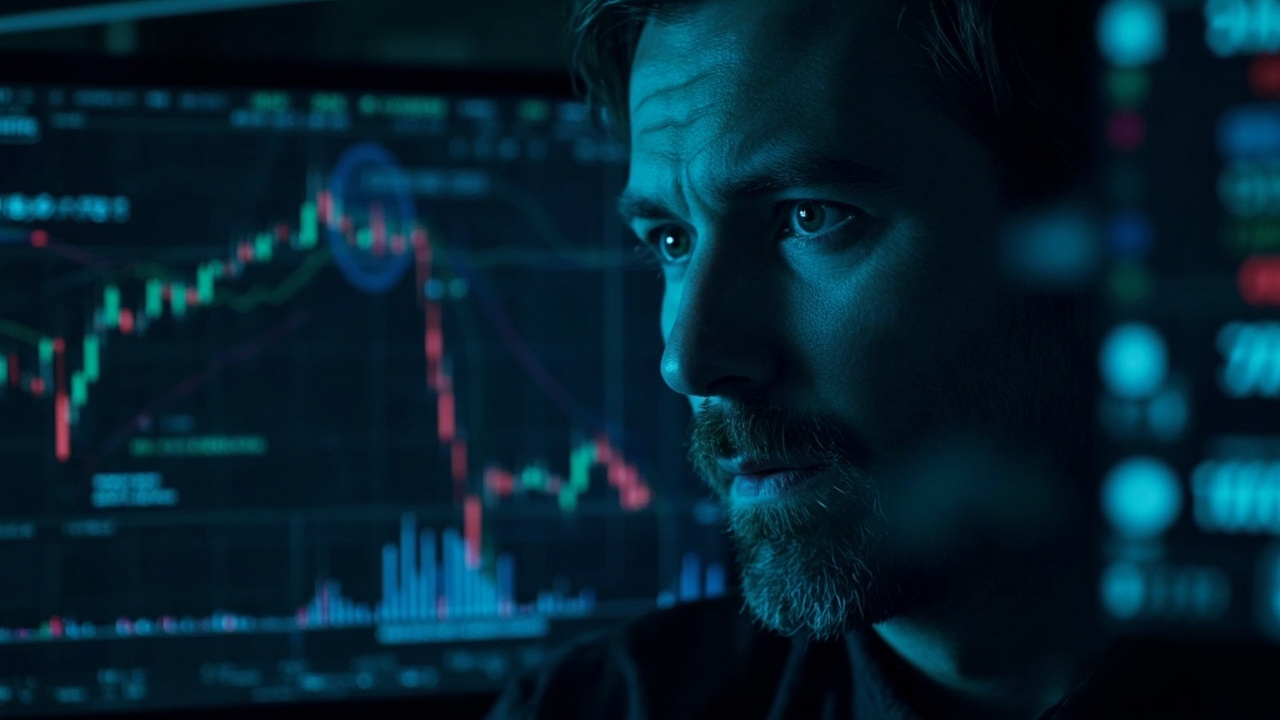
Source context: BullSpot report from 2026-05-29T12:29:39.131Z (Fresh report: generated this cycle).
The Setup Nobody Talks About
Right now, Bitcoin is trapped in a $73,151-$73,924 range. The 4H RSI sits at 42.70, daily RSI at 34.95—neither oversold enough to comfort buyers, neither suggesting momentum. Open interest is locked at $130.60 billion with 61.7% of positions long. That positioning ratio is a warning, not an invitation.
And yet, somewhere, someone is about to buy this dip.
Not because the setup is good. Because they're afraid of missing whatever comes next.
That's FOMO. And it's not a personality flaw—it's a feature of how crypto markets are engineered.
Why FOMO Exists in Every Trader's Head
The mechanics are straightforward. Your brain processes losses and gains asymmetrically. Losing $1,000 feels roughly twice as painful as gaining $1,000 feels good. This isn't a metaphor—neurological studies confirm the asymmetry.
In a rising market, this creates a specific failure mode: you watch something go up without you, and the pain of the missed gain activates the same circuits as an actual loss. You're not losing anything. You just feel like you are. And the brain's solution to pain is action—any action—so you buy.
Crypto accelerates this because of one thing: it publishes prices everywhere. Every second, on every platform, you're confronted with what you could have had. A coin you looked at six months ago. A trade you almost made. The comparison is constant, visceral, and impossible to escape.
The trap isn't that you missed a trade. The trap is that you feel like you lost something you never owned.
Social Media Is the FOMO Multiplier
Here's what most articles skip: FOMO isn't just internal. It's a social phenomenon with industrial-scale amplification.
Crypto Twitter, Reddit, Discord—these platforms are engineered for maximum emotional activation. They reward two things: extreme conviction and urgency. Nuanced analysis gets buried. "This is going to kill it" with a rocket emoji gets engagement.
The feedback loop works like this: a price starts moving, retail traders notice, they post about it, that attracts more attention, more people notice the move, they FOMO in, the move extends, early posters look like geniuses, the cycle accelerates.
By the time the trade is obvious to everyone, the risk/reward has completely inverted. The people who bought at the top become the cautionary tale that fuels the next cycle's FOMO.
This isn't accidental. Influencer culture, pump groups, and even some trading educators profit from engagement, not from your portfolio performance. If calm analysis keeps people scrolling, it doesn't get promoted. If urgency and excitement get clicks, that's what gets amplified.
Spotting FOMO in Your Own Decisions
You don't need a psychology degree to catch this. FOMO has specific signatures.
The most reliable: you're excited about a trade but can't explain why you're entering. Not "I think it will go up"—that's a thesis. I mean you can't point to a specific setup, level, or catalyst. You're entering because you don't want to miss it, and you've dressed that fear in the language of opportunity.
Another tell: you find yourself sizing up as the price moves against you. "If it drops more, I'll average in." This is FOMO rationalization. You're not buying because the setup improved—you're buying because you want to be done with the uncomfortable position of being wrong and out of the market.
Check yourself on timeframes too. If you're making a swing trade decision on a 15-minute chart, you're not investing—you're reacting. FOMO operates on short timeframes because those are where the dramatic moves and social signals live.
The Specific Cost of Chasing
Let's be concrete about the math, because "missed gains are okay" is useless advice without numbers.
Imagine you FOMO into a position after a 20% move. The trade works—you think. It pulls back 10% to "consolidate." You sell at a 5% loss, or you hold through a further 15% decline until you panic out at the bottom.
Now imagine you waited. You entered on the pullback, at better levels. Your stop is tighter, your conviction is higher, your mental bandwidth isn't consumed by regret.
The difference in outcome isn't 5% or 10%. Because of position sizing, conviction, and ability to hold through noise, systematic entries often outperform reactive ones by 30-50% over the same nominal price move.
The missed gain feels large. The actual drag from bad entries is larger.
The Waiting Period Fix
Here's a tool that works: any time you feel the urge to enter a position based on social momentum, write down exactly why you're entering and at what price before you do anything else.
Then wait 24 hours.
This isn't about missing trades. It's about creating separation between emotion and execution. Most FOMO trades look compelling for about 90 minutes and obvious as mistakes within a week. The waiting period lets the trade run through its emotional half-life.
If the thesis survives 24 hours of reflection, it's more likely to be a real thesis and less likely to be a dopamine hit from seeing green candles.
The Real Question About Missing Gains
"Missing gains" is framed as failure, but it's actually the cost of avoiding worse mistakes.
In any given bull cycle, the top 10% of days account for the majority of gains. Missing those days hurts your return. But here's what the FOMO crowd doesn't calculate: if you're in the market for 10 years, the days you avoid due to bad entries probably cost you less than the drawdowns you avoid from not chasing.
The trade-off shifts as you calculate it properly. Systematic investors who missed some of 2017's run-up still outperformed most retail traders who were in the entire time, because they also missed the subsequent 80% drawdown.
Patience is asymmetric. The downside of missing a pump is capped at 100% of that opportunity. The downside of chasing is your entire position.
Building a System That Doesn't Need Willpower
Willpower is finite. If your strategy requires you to resist FOMO constantly, you'll fail eventually. The goal is to make FOMO-driven decisions structurally impossible.
Concretely: pre-define your entries before you see setups. Write them down. Set alerts, not watchlists. A watchlist keeps you scanning for emotional triggers. An alert waits until a specific condition is met and then notifies you.
Your entry criteria should be mechanical enough that you could hand them to someone else and they'd execute similarly. If you need to "feel" the trade, you don't have a system—you have intuition that will betray you when emotions run hot.
This isn't about being mechanical. It's about being consistent enough that your edge has room to work. FOMO destroys edges by forcing entries at the worst possible prices with positions too large for the conviction level.
What This Looks Like in Current Conditions
Back to right now: BTC compressed in a $773 range, RSI weak across timeframes, crowded long positioning. The social environment is likely at elevated fear—the report notes Reddit sentiment at -54 across major crypto subs.
That's important context. Extreme fear creates a specific FOMO variant: fear of missing the bottom.
People see a declining price and assume the opportunity is the low. They buy before the actual bottom because the pain of watching a falling price becomes unbearable. Then they watch it fall further, lose conviction, and sell at the worst time.
The bottom isn't a price. It's a process. You don't catch it by rushing—you catch it by being systematically present at defined levels, not by reacting to each new low.
The Takeaway
FOMO isn't your enemy because emotions are bad. It's your enemy because crypto markets are specifically designed to exploit your psychological wiring for the benefit of people with faster information, better positioning, and different incentives.
You don't beat FOMO by trying to feel less. You beat it by removing the decisions from the moments when you'd make them badly.
Pre-define entries. Use alerts instead of screens. Wait 24 hours on impulse decisions. Calculate the actual cost of chasing versus waiting—and notice it's lower than it feels.
In a $773 range with RSI showing no oversold relief and 61.7% of positions crowded long, the specific move worth avoiding is the reflexive "this dip is the opportunity" trade. Sometimes a dip is a dip. Sometimes it's the setup for the squeeze that takes out the crowded longs.
Patience in those moments isn't boring. It's the edge.